COSTOFEXCLUSION

Afghanistan · Girls banned from school

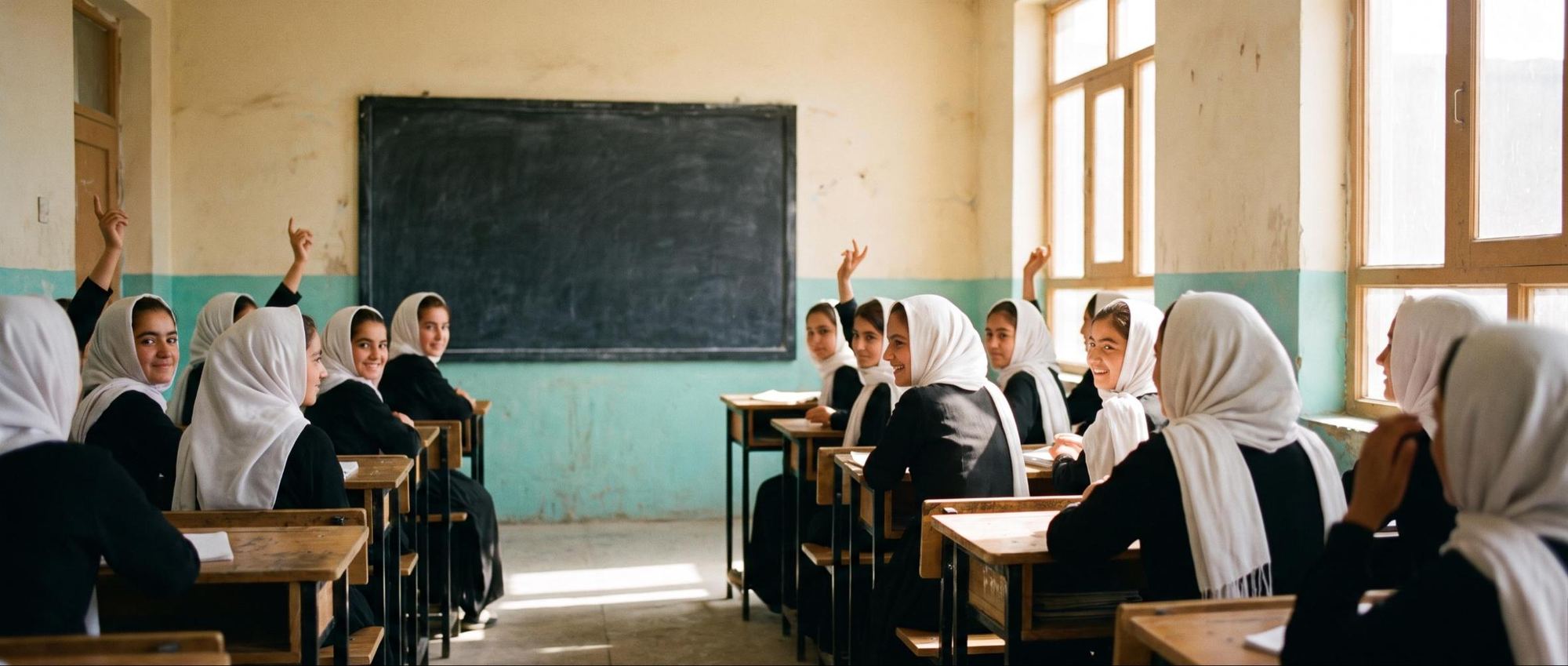
Her school ended at grade 6.

Afghanistan is the only country in the world that does not let girls go to school after grade 6. This clock started on the day schools reopened for boys only.

1,891
Days
00
Hours
00
Minutes
00
Seconds

Started Saturday 18 September 2021, 8:00 in the morning, Kabul time.

Download the full reportPDF · 75 pages · 4 MB
Girls stop here 123456789101112
Open to girlsClosed to girls since 2021

Grades 7–12, university, nursing and midwifery: closed to girls and women

Live count

What the ban has cost so far

These numbers change while you read. Each one is labelled: a fact, a UN estimate, or our projection.

Live estimate
5,456,000
years of school lost by girls

About 1 million girls lose a year of school for every year the ban lasts.

UN estimate
2,304,000
girls kept out of secondary school

About 1 million were already in grades 7–12 in 2021. About 250,000 more are stopped at grade 6 every year.

Live estimate
408,000
girls who should have finished high school by now

Projection
58,900
women teachers left in schools (estimate)

Projection
6,250
midwives left (estimate)

UN estimate
US$435,000,000
lost to the economy so far

Using UNICEF's lowest estimate of US$84 million a year. Other estimates go up to US$1 billion a year.

Fact
0
girls allowed into grade 7 since 2021
Fact
0
women allowed to become doctors since 2023

Women cannot take the final exam.

Fact
0
women allowed to train as nurses or midwives since Dec 2024

About 35,000 students were sent home.

Fact
100,000+
women sent home from university in December 2022

Countdowns

What happens next if the ban continues

No new women can become teachers or midwives, so their numbers can only go down. These clocks count down to key moments. Choose a scenario to see how the dates change.

Projection

If the ban ended today, the first new midwife could start work on

—

How the scenarios differ. Best case: women teachers leave at today's rate, about 5% a year. Middle case: more leave the country and lose their skills, 6% a year. Worst case: 8% a year. Midwives follow the same pattern.

The girls

A lost generation

About 1 million girls were in secondary school when it closed. Every year, 250,000 more are stopped at grade 6. The longer the ban lasts, the fewer will ever return.

UN estimate

Girls out of secondary school, according to the UN

These UN numbers also include girls who were out of school for other reasons. The light bar for 2030 is a UN projection.

Fact

How the ban grew, step by step

  1. Secondary schools reopen for boys onlyGirls must stop at grade 6
  2. The promise to reopen girls' schools is brokenThe ban has no end date
  3. Women banned from universityOver 100,000 students sent home
  4. All 49 teacher-training centres closedNo new teachers can be trained
  5. Women banned from nursing and midwifery trainingAbout 35,000 students sent home
  6. Books banned, internet cut, new laws against womenSchools still closed in November 2026
Example

One girl: 15 years old when her school closed

Her plan
What happened
2021
Grade 9
School closed to her
2022
Grade 10
Universities closed to women
2024
Finishes high school
Nursing and midwifery closed to women
2026
Working as a midwife or teacher
Age 20. Out of school for 5 years.
2030
Experienced professional
If the ban ends: age 24, back in grade 9

In the middle case, fewer than 1 in 5 of these older girls go back to school, even if the ban ends in 2030.

Projection

Girls who will never go back to school

BestMiddleWorst

Older girls are less likely to return. Many marry, have children or leave the country. Return rates for women over 20 are our estimates.

Teachers

Women teachers are not being replaced

Many families only send their daughters to a woman teacher. Girls can still go to primary school, but no new women teachers are being trained. Villages lose them first.

Projection

Women teachers if the ban continues

Real countBestMiddleWorst

Black dots are real counts from UNICEF. The lines show what happens with no new teachers. The grey line is today.

Projection

Women teachers per school, by province (middle case)

Kabul (67% women)Average (36%)17 provinces under 20%7 provinces under 10%

Before the ban, 1 in 100 teachers in Paktika was a woman. In Kabul it was 2 in 3. Below the line marked 1, the average school has no woman teacher.

Projection

Girls per woman teacher

BestMiddleWorst

Today about 45 girls share one woman teacher. That number keeps rising.

Health

Mothers will pay first

Many families will not let a man help a woman give birth. Without midwives, more women give birth with no trained help. It took Afghanistan 20 years to train its midwives. The ban is undoing that.

Projection

Midwives: 20 years to build, now going down

Real countBestMiddleWorstMidwives needed: about 24,000

467 midwives in 2002. 6,746 in 2023. The lines show what happens with no new midwives.

Projection

Share of births a midwife can attend

BestMiddleWorst

Based on about 1.5 million births a year and 175 births per midwife.

Fact

Already far below what is needed

Mothers' deaths: in 2002, about 1,600 mothers died for every 100,000 births. By 2023 it was 521. If midwives disappear, tens of thousands more mothers could die by 2040. This is a rough estimate, not an exact forecast.

Women's lives

Women's lives, and their children's

Surveys of Afghan women show the same picture every year. A mother's education also shapes her children's health.

Fact

What Afghan women say

UN Women survey of 2,811 women, 2026.

Fact

Mothers with and without education

Less educationMore education

From Afghanistan's national survey (MICS 2022–23). Part of the gap comes from wealth and where families live.

Projection

Girls who will have no woman teacher

BestMiddleWorst

Based on 45 girls per woman teacher and about 3 million girls in primary school.

Recovery

If the ban ended, how long to fix the damage?

Move the slider to pick the year the ban ends. All the numbers below update.

2030

Each year of delay adds about 250,000 girls. Older girls are less likely to return.

Projection

Women teachers after the ban ends

BestMiddleWorst2024 number
Projection

Midwives after the ban ends

BestMiddleWorstToday's number
Projection

Best, middle and worst case for the year you chose

The middle case is the most likely. "Never" means the numbers do not recover without help from outside the country.

The quickest fix

Bring back the 135,000 women who were sent home in the middle of their studies

Economy

The cost to the economy

Estimates range from US$84 million to US$1 billion a year. They only count lost wages. They do not count lost teachers, sick children or lost aid.

UN estimate

Yearly cost estimates (US$ millions)

Do not add these together. Each one measures something different.

Projection

Lost aid may cost even more

Aid is worth about US$2 billion a year to Afghanistan. The World Bank says the bans on women have reduced aid.

US$ millions a year. Nobody has measured the exact amount.

92%

of Afghans say girls should be allowed to keep studying. That includes 87% of men in villages.

UN Women survey of 2,190 people, 2025.

About the data

Where these numbers come from

This website and the research report The Cost of Exclusion (November 2026) were prepared by a group of Afghan girls in Afghanistan. For their safety, their names are not published. All numbers come from the report. Outside experts have not yet reviewed its models.

Download the full reportPDF · 75 pages · 4 MB

Labels used on this page

Fact
A real count or survey result.
UN estimate
A number published by a UN agency.
Projection
Our calculation of what could happen. It shows a likely range, not an exact prediction.
Live estimate
A yearly number spread across the year, so it moves while you watch. It shows the pace of the loss, not an exact count.
Feedback
Found a mistake, or have newer data? Write to us at costofexclusion@gmail.com
Last update
November 2026. Updated every year when new data is published.